Five views and twenty-six decisions

Roar Georgsen, 27 August 2026

Part 7 of 11 in Federating a systems model.

The demo is a SysML v2 model of a five-server query pipeline, published as one federated GraphQL graph by three services in one container, with a capacity analysis and a requirements document joined to the model by the router that merges the three schemas, and edits from either app landing in the model text. Its architecture description was written for two readers who want different things from it, and a later reading of the description against the requirements changed several mechanisms without changing any decision. The architecture in one sitting covers the same ground at one sitting’s length, and an A3 sheet for a fifteen-minute reader is what was cut from it.

An architecture description for two kinds of reader

The entity of interest is the demo: the adapter, the example stack behind it and the image they ship in. The pipeline the example models, with its ingest, parse and index servers, is a system the demo describes and not a running system anywhere. The description never lets the two blur.

ISO/IEC/IEEE 42010 supplies the vocabulary: stakeholder, concern, viewpoint, view, decision, rationale. The description follows the standard’s concepts “without a claim of conformance”, which is an honest phrase. The concepts sort the material, and nobody has audited the document against the standard’s own requirements.

Five stakeholders are named, each with a question and each pointed at the views that answer it. For the visitor the questions are whether it launches at all and whether what it shows is something they would not have believed. The model owner’s concern is that the model stays the source and that an edit anywhere lands in it. The document owner wants to shape the document without touching the model and still see what the model knows. A maintainer, or a contributor, asks whether it can be read in an afternoon, built with Go alone and changed one service at a time. The fifth is an organisation deciding whether the approach fits, which asks what the services have to agree on and what it would have to replace. That last row is the reason the series exists, and the later reading found that the description had promised it an answer without giving one. The answer it gained is the adoption contract stated in The architecture in one sitting.

A viewpoint definition sits above the views: each is a model of one kind, drawn in one notation, with a text form in the description and a board on the canvas. Because five views of one thing can drift apart, the description states how they correspond. Three subgraphs, each a GraphQL service that owns part of a merged schema, carry the names model, capacity and document into composition, run as the three goroutines in the deployment view’s process tree, listen on the ports that view names, and are the packages adapter/ and examples/pipeline/{capacity, document}/ in its layout. The table of who resolves which field is the contract a test guards against drift, and the field sets the capacity service requires are what step 5 of the runtime view carries between services. The adapter view’s packages are the adapter’s single box in the other views.

The five views

Context

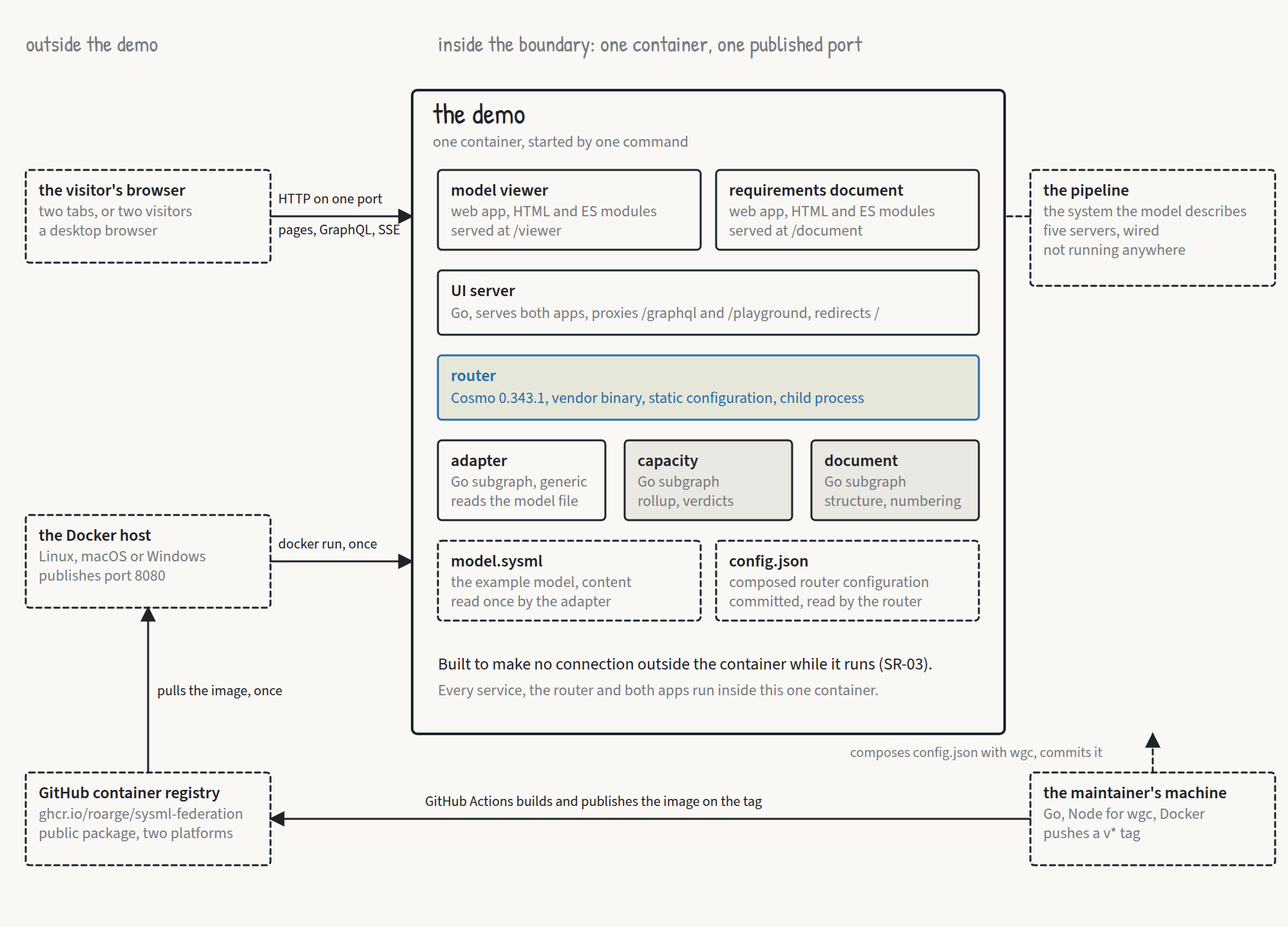
The context view: the demo as one box, with the browser, the Docker host and the registry outside it

The context view draws the demo as one box and the browser, the Docker host and the container registry as dashed boxes outside it. The boards are collected in the architecture views PDF.

Inside the boundary: three subgraphs, one router, one UI server and two web apps, all in one container, started by the docker run --rm -p 8080:8080 ghcr.io/roarge/sysml-federation that the first release will publish. The router is the process that merges the parts of the schema and plans each query across them. Outside the boundary: a browser with two tabs, or two browsers, the Docker host, the GitHub container registry the image is pulled from once, and nothing else. The demo is built to make no connection outside the container while it runs, and a demonstration under --network none is what shows it.

Two things sit at the edge and are easy to mistake for the inside. The example model file is content the adapter reads, authored in the repository rather than produced by it. The Cosmo router is a vendor binary copied into the image and driven only by configuration and environment. What crosses the boundary is short to list: HTTP requests from the browser to one published port, the image pull, and the composition step and the tags that publish the image, neither of them run from the container.

Composition

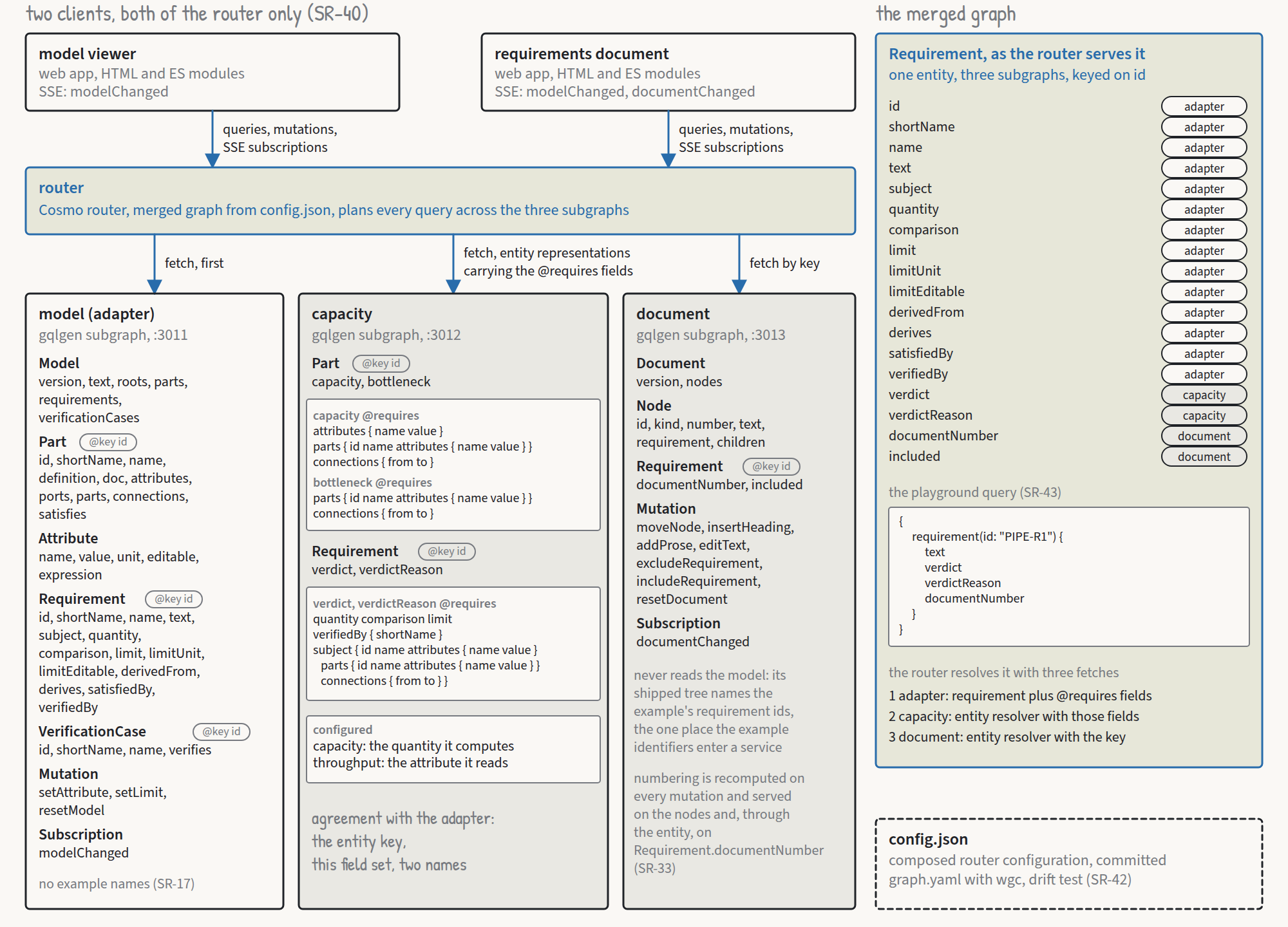
The composition view: three subgraph schemas, their entity keys and the merged Requirement

The composition view shows the three subgraphs, which service resolves every field, and the merged graph in which one requirement carries fields from all three.

The three subgraphs resolve disjoint fields. The adapter resolves everything that comes from the source, the three mutations and the model subscription. The capacity service resolves Part.capacity, Part.bottleneck, Requirement.verdict and Requirement.verdictReason, computed on read from the fields it requires. The document service resolves the document query, the tree of nodes, Requirement.documentNumber, Requirement.included, its seven mutations and its subscription. The table says “resolves” rather than “defines”, a change the review asked for, because the capacity subgraph declares fields the adapter owns.

The entity types are Part, Requirement and VerificationCase, keyed on id. An entity key is the field by which the router recognises the same object in two subgraphs, and here it is the SysML short name or, where an element declares none, its qualified name. The entity resolvers, generated from the @key directives, are the inter-service contract as it exists in code.

The three subgraph schemas side by side

The three subgraph schemas as columns: the adapter’s generic projection, the capacity service’s external fields and requires selections, and the document service’s tree.

The adapter’s schema is generic and names nothing from the example. Its projection, meaning the set of GraphQL types it publishes from the model, is Model, Part, Attribute, Port, Connection, Requirement and VerificationCase. The mutations setAttribute and setLimit accept any value that is a literal in the source and refuse the rest with an error naming the element and the reason.

What the capacity service agrees to is the interesting part. It carries two configured names, capacity and throughput, and no other word of the model. Its requires selections read the subject’s attributes, its child parts with their attributes, and the connections between them, and part names travel in every selection because the reason strings name the servers in the cut that limits the flow:

capacity: Float
  @requires(fields: "attributes { name value } parts { id name attributes { name value } } connections { from to }")

The value types carry @external on the fields the selections read and no @shareable, the shape the vendor documents for nested requires, and VerificationCase is keyed resolvable: false because the capacity service only reads it. Whether Cosmo composition and gqlgen accept this exact shape is the first implementation spike, covered in article 09, and the description carries a fallback, Part.wiring: String, a JSON document of the children and connections that the capacity service would require instead.

The document service’s shipped tree names the example’s requirement ids in a configuration file, the one place the example’s identifiers enter a service. It never reads the model. A requirement not in its tree is not in the document, and for an id it has never heard of its entity resolver answers included: false and documentNumber: null. The description states this limit in the field table, beside the playground query and in the example README.

Composition merges the three into one schema in which Requirement carries text and limit from the adapter, verdict and reason from the capacity service, and number and inclusion from the document service. A verdict is the capacity service’s judgement of one requirement, PASS, FAIL, INCONCLUSIVE or ERROR, with a reason string beside it. The query the visitor runs in the playground, against the model requirement PIPE-R1, is

{
  requirement(id: "PIPE-R1") {
    text
    verdict
    verdictReason
    documentNumber
  }
}

and the router resolves it with three fetches: the adapter for the requirement and every field the capacity service requires, the capacity service’s entity resolver with those fields as the representation, and the document service’s entity resolver with the key.

The compose input and its output are committed at examples/pipeline/, and a Go test compares each schema embedded in the output with the file it came from. The vendor says of this static path that “it is recommended to not use this for production”, and the router logs “Not recommended for Production” at every start without a graph token. The demo has no control plane to fetch from, so the static path is the only one, and the answer to the caveat is the drift test and pinning the router and the compose tool together.

Both apps are clients of the router and of nothing else. The viewer subscribes to modelChanged, the document app to both modelChanged and documentChanged, and each refetches its whole query on every event. Neither app renders from a mutation’s response, and neither computes anything it shows.

Runtime

The runtime view: seven numbered steps from a value edit to both apps rendering

The runtime view follows one edit from the viewer through the router, the adapter and the capacity service to both apps rendering.

The view is one edit, in seven numbered steps from a value changed in the viewer through the router, the adapter and the capacity service to both apps rendering, ending with the viewer’s red outline moved off parse and on to the index pair whose combined throughput now bounds the flow. That set is the minimum cut, the smallest set of parts whose throughput bounds the whole, which is what the demo calls the bottleneck. The architecture in one sitting narrates the sequence and the nothing-moves variant of it, and the whole of it is bounded by the two seconds the requirement allows. The view’s own contribution is what the numbered steps leave out.

A document edit is shorter. Moving PIPE-R2 under PIPE-R1 goes to the document service alone, which reorders its tree, renumbers, increments its version and emits documentChanged. The viewer is not subscribed to document events and does nothing, and the model version is unchanged. That asymmetry is the whole of what the document owner is promised: shape the document without touching the model.

Reset from either app is one mutation document with both root fields, mutation { resetModel { version } resetDocument { version } }. The router plans the two fields to the two services, each restores its shipped state, increments its counter and emits its event, and both apps refetch. The apps send both because neither service knows about the other.

Startup has to be right once. serve starts the three subgraphs as goroutines on loopback ports, waits for each to answer its health endpoint, starts the router as a child process, waits for /health/ready on the router’s loopback port, and only then opens the published port. What /health/ready reports before the subgraphs answer is a spike, and the ordering does not depend on it.

Deployment

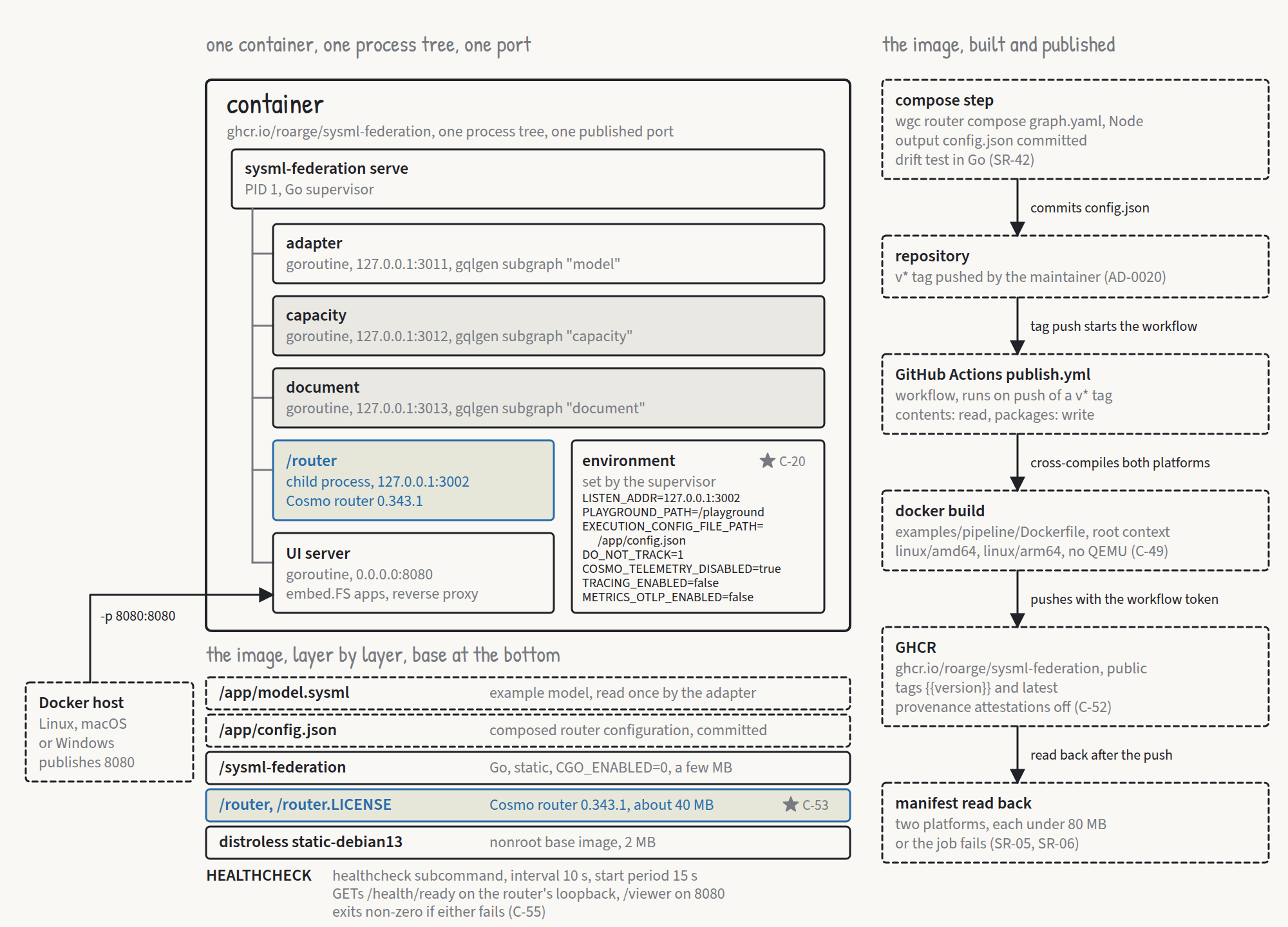
The deployment view: the process tree, the Dockerfile stages and the tag-triggered publish

The deployment view shows one container with one process tree, the three build stages and the workflow that publishes on a version tag.

PID 1  sysml-federation serve            Go, supervisor, PID 1
  |-- goroutine  adapter        127.0.0.1:3011   gqlgen subgraph "model"
  |-- goroutine  capacity       127.0.0.1:3012   gqlgen subgraph "capacity"
  |-- goroutine  document       127.0.0.1:3013   gqlgen subgraph "document"
  |-- child      /router        127.0.0.1:3002   Cosmo router 0.343.1
  \-- goroutine  ui server      0.0.0.0:8080     static apps, proxy

The UI server serves /viewer and /document from an embedded filesystem, proxies /graphql and /playground to the router, and redirects / to /viewer. A healthcheck subcommand probes the router’s /health/ready on its loopback port and /viewer on the published port and exits non-zero if either fails. The router’s health path is not proxied, so the four paths just named are all the published port serves.

The Dockerfile has three stages. A Go build stage cross-compiles the binary for the target platform. A stage named router is the vendor’s image at the pinned version, from which /router is copied. The final stage is a distroless static base running as nonroot, into which go the router binary, the demo binary, the committed configuration and the model file. The router’s licence is fetched at build time from the vendor’s repository at the pinned tag with a pinned checksum, so it cannot drift from the binary’s version. Whether COPY --from of a multi-platform image resolves the target platform’s binary is a spike. The router is about 40 MB compressed, the demo binary a few MB and the base 2 MB, against a budget of 80 MB.

Publishing runs on a pushed v* tag, builds linux/amd64,linux/arm64 by cross-compilation with no QEMU, tags with the semver version and latest, pushes, then reads the manifest back and fails the job if either platform is missing or over budget.

The adapter

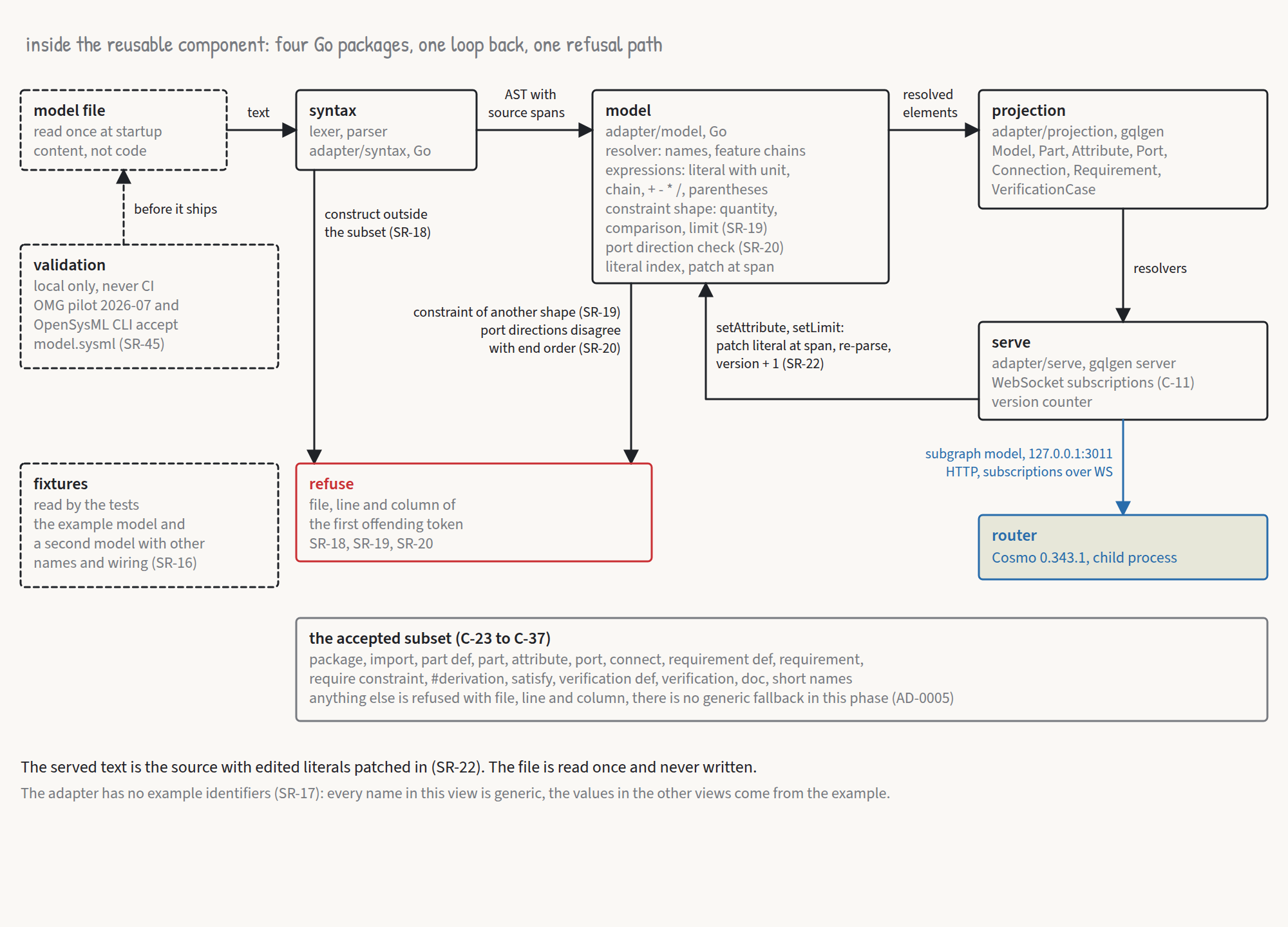
The adapter view: files through lexer, parser, resolver and projection to gqlgen, with a patch arrow back to the AST

The adapter view is a pipeline of four packages, with the patch path from a mutation back to the syntax tree.

files --> lexer --> parser --> AST with spans --> resolver --> projection --> gqlgen
                                   |                              ^
                                   +---- patch literal at span ----+   (setAttribute, setLimit)

syntax turns the text into tokens and the tokens into a tree in which every node carries its byte range in the source. It accepts a strict subset of the textual notation, listed construct by construct, and refuses anything else with the file, line and column of the first offending token. It has no opinion about meaning.

model resolves names, which means qualified names, short names and feature chains through a requirement’s subject and its part usages. It evaluates the bound expressions the subset allows, a literal with an optional unit, a feature chain, the four arithmetic operators and parentheses, which is exactly enough to bind the derived limits to PIPE-R1’s. It reads the shape of every require constraint into a quantity, a comparison and a limit, checks port directions against connection end order, and keeps the source text with an index from every numeric literal to its span. Patch(span, newLiteral) replaces the text and re-parses, so the served text and the projection are rebuilt together and can never disagree. The spans are what make editing possible without the adapter holding a second representation of the model.

projection maps resolved elements to the schema’s types and holds nothing the schema does not show. serve is the gqlgen server with WebSocket subscriptions, the entity resolvers, the store that hands each operation one snapshot of the current model, and the version counter that store increments on every accepted mutation and on reset.

A second fixture model with other names and wiring is part of the adapter’s tests. The escape hatch the README leaves open, a generic type for elements nobody has projected, is not built in this phase, and a construct outside the subset is refused rather than served generically, which is the smaller first cut. A subset parser cannot prove that a file is valid SysML, so the example model is checked with the OMG pilot and the OpenSysML command line before it becomes a fixture, locally and never in CI, and the releases used are recorded in the example’s README.

Twenty-six decisions

The records are in the Nygard form, context, decision, alternatives, consequences, requirements affected and sources, and all twenty-six are accepted. They are indexed at docs/decisions. Twenty-four were written from decisions already taken in the brief, the plan and the engineering log. Two more were written after the traceability showed six requirements with no decision behind them: the document owning its structure and the viewer’s form were real decisions that had never been recorded.

The shape of the system is six records. The model, the analysis and the document structure are three independently owned subgraphs behind one router, with no service reading another’s data, which is federation over a single service. The platform is Cosmo, pinned to router 0.343.1 and a matching compose tool, run from a static execution configuration with no control plane and no graph token. Everything ships as one binary, one process tree and one port, with the router run as a child process from the copied binary. Composition is a maintainer step whose output is committed and tested for drift, and the router’s telemetry is disabled by environment baked into the image.

Five records cover the analysis. The example’s capacity arithmetic is idealised, with no queueing, balancing or latency, and says so. Rollup is maximum flow with the source-side minimum cut as the bottleneck. A requirement’s quantity, comparison and limit are read from its constraint rather than declared anywhere else. Connection direction comes from the order of the ends in the connect statement, and the adapter refuses to start on a connection whose ends face the wrong way. Every verdict reason is built from fixed templates in the capacity service. The capacity model is treated in full in article 05.

Six belong to the adapter. It reads files rather than fronting a repository, and a counter that only grows stands in for commits. Value edits arrive as three mutations and are applied by replacing a literal at its span, which the record calls editing as scaffolding. The model is published through a curated generic projection rather than types generated from the metamodel. The parser is hand-written and accepts a strict subset. Elements are identified by short names, with the qualified name as fallback. The target is SysML 2.0 formal, validated with the pilot and OpenSysML.

Four of the records are about the two apps. Subscriptions carry nothing but a version number, and each app refetches on the event. Both apps are plain HTML, CSS and native modules with one vendored file, no build step and no node_modules. The document owns its structure and nothing else, an ordered tree of heading, prose and requirement nodes numbered from the tree alone. The viewer shows the model’s text beside a sketch of its wiring, a record the index says is due for amendment when the apps ship, because the editable numbers moved to a panel above the text.

What is left is the repository itself. Generated code is exempt from the empty-interface rule and every hand-written file stays under it. The image is published by a tag-triggered workflow. The Markdown description is the record and the A3 sheets are the overview. Two test helper packages under internal/ are tracked as ordinary Go packages so that tracked tests may import them. And the artefacts are numbered under a light scheme, with a number never reused and a replaced decision getting a new one.

The traceability was regenerated with a decision column and a table from records back to requirements. Every one of the forty-five requirements is affected by at least one record.

What the review changed

Nothing the reading found overturned a decision, and every fix was local. That says the decisions had settled before the description was drawn. What changed were mechanisms.

Three of them. Because the reason strings name the servers in a cut, the requires selections gained name beside id and the capacity subgraph declares Part.name external. The licence moved from a copy out of the image to a checksummed fetch, which needs no allowlist rule. And the health check moved off the published port for the router.

Smaller settlements from the same reading: VerificationCase keyed non-resolvable, explicit_requires chosen and preloaded_requires excluded because it rejects nested fields, and a non-numeric literal refused at parse time so that the capacity service’s ERROR case is missing or negative only.

The additions are what a systems-engineering reader expects. Viewpoint definitions, a correspondence statement between the views and the paragraph on what an adopting organisation agrees to and replaces were all added. The field table gained the rows it had omitted, the query roots, ports and connections. The document service’s limit is stated, with its answer for an unknown id defined.

The records went through a reading of their own against the sources, which corrected misattributions, among them an inverted reading of the router compatibility rule, a claim that the whole capacity service is a few dozen lines when only the flow algorithm is, and an unsourced reason for leaving the escape hatch open.

A final reading of the twenty-six records against the revised description, the traceability and the six boards found record sentences still carrying the earlier design: the health check through the published port, the licence copied rather than fetched, conditional wording on the internal/ additions, reset as one mutation per service, and a stale count of the records themselves. The composition board’s requires field sets lacked the part names the revision had added, and the overview board filed the deciding organisation under the context view rather than composition. All were corrected. After that, every reference anywhere in the set resolves.

The canvas

Six boards: an overview and one per view. The first two were drawn with the description, the other four from it after the review, each checked against the text. They share one legend: plain ink for a component of the demo, named with its type and technology, a shaded box for one owned by the example rather than the adapter, blue for the router and what is shared through it, a dashed outline for something outside the demo, and red for a failing requirement or a bottleneck and nothing else. Arrows are labelled and one-directional. The blue tint of the boxes was aligned with the legend swatches in the final pass.


Previous: From use cases to requirements · Index: Federating a systems model · Next: An A3 sheet for a fifteen-minute reader